About Protection Devices
Technical details
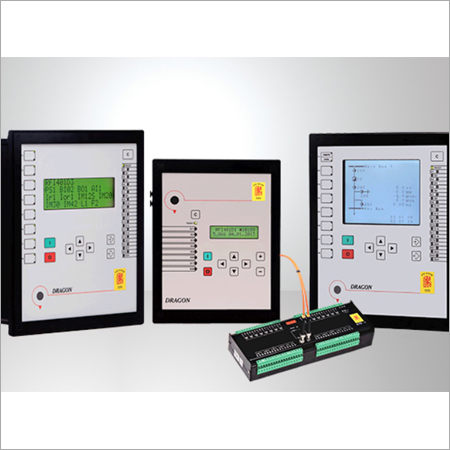
- User defined configurations and setting parameters with events and disturbance recording functions
- Analogue input card is built with Electronic Voltage and Current transformer instead of Electromagnetic for high accuracy and linear Characteristics
- Complies with IEC, EN and BIS standards
- Communication protocols and interfaces meet IEC 61850 edition 2
- Compact housing enables fast installation and Commissioning
- Remote Terminal Blocks permit easily expanding Input\Output Analogue/ Digital signals
- Fibre Optic interface enables the remote I/O expansion upto 2km length
- Protection include Distance, Line Differential, Transformer Differential, Busbar, Overcurrent/Earth Fault Backup, Voltage/Frequency, Motor, in Transmission lines\Bus bars\ Transformers\Reactors\Motors\Bay Control Unit
- Proven anti-islanding feature for Solar and Wind Generators
- Vector Shift protection default for Voltage input devices
- Arc Protection feature default for all devices
- Meets SCADA Communication protocols IEC 61850 ed1/ed2, IEC 60870-103/ IEC 60870-104, Modbus-RTU, Modbus-TCP
- Meets process level communication protocol IEC 61850-9.2LE and IEC 61850 edition 2 with zero recovery time as per IEC 62439-3 at process level
- Meets station level communication protocol IEC 61850 edition 2 with zero recovery time as per IEC 62439-3 at station level
Instantaneous Protection, Lasting SafetyEngineered for rapid response, this device clamped voltage at less than 1.2kV and activates within 25 nanoseconds. It reliably shields your electrical systems from surges and faults, promoting operational continuity and safety. Its durable build and replaceable module ensure both long-term use and ease of maintenance, making it an excellent choice for demanding environments.
Designed for Versatile Electrical ApplicationsThis protection device accommodates a wide array of applications, including residential, industrial, and commercial setups requiring high-level surge protection and short-circuit defense. Its compatibility with standard DIN rails, dual-pole support, and robust construction with polycarbonate and brass make integration both simple and secure.
FAQs of Protection Devices:
Q: How does the status window help in monitoring the devices operation?
A: The status window allows users to easily verify the operational state of the device at a glance, making it simple to determine if the module is functioning correctly or requires replacement.
Q: What is the installation process for this protection device?
A: Installation is straightforward due to its DIN Rail Clip connector type and standard DIN rail size. Simply fix the device onto the DIN rail and use the screw terminals to connect your wiring securely.
Q: When should the replaceable module be changed?
A: The module should be replaced if the status window indicates a failure or after experiencing a surge event that exceeds the devices nominal discharge capabilities, ensuring continued protection and reliability.
Q: Where is this device typically used?
A: This device is used in electrical panels for residential, commercial, and industrial environments where high-level surge, short circuit, and overvoltage protection are required.
Q: What are the benefits of choosing this protection device over others?
A: Key benefits include highly efficient surge protection, quick response time, replaceable modules for easy servicing, compliance with RoHS for environmental safety, and straightforward DIN rail mounting.
Q: How does the device maintain electrical safety and equipment protection?
A: It provides reliable defense by quickly diverting excessive surges and preventing overvoltage damage, supported by both short circuit and overheating protection mechanisms.
Q: What materials are used in the construction of this device and why are they important?
A: The device is manufactured using polycarbonate for insulation and brass for electrical connections, ensuring long-lasting durability, electrical safety, and robust performance in demanding environments.


 Send Inquiry



 Send Email
 Send Inquiry

 Send Inquiry

 Send Inquiry
 Send SMS
 Call Me Free


