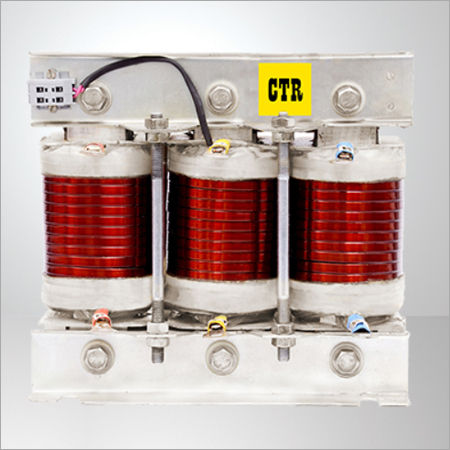
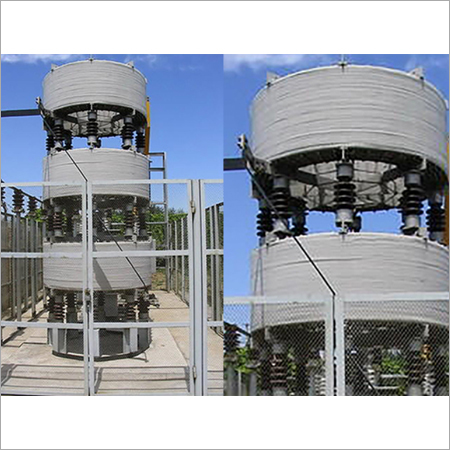
About Series Shunt Harmonic Filter Reactors (Low Voltage)
Series Shunt Harmonic Filter Reactors (Low Voltage) Features
- Voltage 440V to 850V
- Reactive Power from 5 to 250 KVAR
- Voltage drop 0.2 % and 5.67 / 6 / 7 / 12/ 14 %
- High level of safety provided through Internal fuse and Optional Over temperature sensor
- Includes compact discharge resistor
Frequently Asked Questions:
What is a shunt filter?
To balance the imbalance currents and correct reactive power, shunt active filters are employed to correct current harmonics of nonlinear loads. To counteract current harmonics or reactive load, a shunt active filter detects the load current and injects a current into the system.
What is the purpose of a harmonic filter?
Harmonic filters reduce distortion by diverting harmonic currents in low-impedance paths. Harmonic filters are capacitive at the fundamental frequency, so they are also used to produce the reactive power required by converters and for power factor correction.
Why is the harmonic series important?
Brass instruments, in particular, benefit greatly from the harmonic series. A pianist or xylophonist can only produce one note per key. When a string player wants a certain note from a string, they grip the string tightly in that location. In essence, this creates a vibrating string with a new length and fundamental.
Why is it called harmonic series?
The harmonic sequence is so named because it is exactly the sequence of points on a taut string that deliver musical "harmonics" when the string is touched there as it is plucked.
Who proved harmonic sequence?
The study of harmonic sequences dates to at least the 6th century bce, when the Greek philosopher and mathematician Pyt
Superior Harmonic SuppressionThe Series Shunt Harmonic Filter Reactors are specifically designed to mitigate unwanted harmonics in low voltage electrical systems. They target major harmonic orders, such as 3rd, 5th, 7th, 11th, 13th, and above, significantly improving system performance by reducing distortion and increasing equipment longevity.
Robust and Reliable ConstructionBuilt using high-quality copper or aluminum windings and silicon steel laminated cores, these reactors ensure durability and efficiency. Their robust design, powder-coated surface, and IP20 protection make them suitable for Indian industrial environments, supporting prolonged operation under high thermal and humidity conditions.
Flexible Installation and OperationWith panel or floor mounting flexibility and options for star or delta connection, the reactors can be seamlessly integrated into existing systems. Their noise level is maintained below 55 dB, and thermal class F/B insulation provides overheating protection, ensuring stable performance even at temperatures between -25C to +45C.
FAQs of Series Shunt Harmonic Filter Reactors (Low Voltage):
Q: How do Series Shunt Harmonic Filter Reactors improve power quality in low voltage systems?
A: These reactors filter out harmonic currents (up to the 13th order and beyond) generated by non-linear loads, effectively reducing voltage and current distortion. This leads to improved power factor, minimized energy losses, and enhanced protection for sensitive electrical equipment.
Q: What is the typical process for installing these harmonic filter reactors?
A: Installation involves connecting the reactor in a shunt configuration to the low voltage bus or system, typically using a star or delta connection. Mounting can be on panels or floors, and wiring is done via terminal blocks or bus bars according to system specifications.
Q: When should these reactors be used in an electrical system?
A: They should be used when your electrical network exhibits a poor power factor, frequent tripping of circuit breakers, or signs of harmonic distortion such as overheating of equipment, unexpected noise, or malfunction of sensitive devices.
Q: Where can these series shunt harmonic filter reactors be applied?
A: They are ideal for application in power factor correction and harmonic filtering within commercial, industrial, and institutional facilities that operate low voltage electrical systems up to 415 V AC.
Q: What benefits do these reactors offer over standard reactors?
A: These reactors are specifically designed for harmonic mitigation with high linearity, robust thermal stability, and low power loss. Their superior construction ensures efficiency above 98%, reliable operation in harsh environments, and reduced total ownership costs.
Q: How are the sizes and ratings of the reactors determined?
A: The required size and rating depend on the level of harmonic distortion present, system voltage (415 V AC), load current, and specific application requirements. Custom dimensions and ratings are provided based on user load analysis.
Q: What protection features are included in these reactors?
A: They include thermal class F/B insulation for overheating protection, short circuit withstand capability up to 2.5 times the rated current (for 2 seconds), IP20 protection rating against solid objects, and powder-coated finishes for corrosion resistance.


 Send Inquiry



 Send Email
 Send Inquiry

 Send Inquiry

 Send Inquiry
 Send SMS
 Call Me Free


